
7/22/2026 · Goodchoice Team
How to Find and Download Full-Resolution Images from a Website
If you need to find and download full-resolution images from a website, the hard part is usually not clicking Download. The difficult part is getting a file that is right for the next job: the right image candidate, the right dimensions, and the right format. The image you see on a page is often scaled down for the layout. If you need it for a mood board, product audit, client presentation, or creative reference, a small display version can become unusable the moment you zoom in. This guide explains a repeatable Chrome workflow that replaces guesswork with a clear source-and-format decision.
Why this problem keeps appearing in Chrome
Pages may use responsive sources, lazy loading, and background images to keep loading fast. These choices are good for visitors but make it less obvious which available image candidate has the dimensions you need. What you see in the browser is not always the file you should keep. Websites optimize assets for layouts, connection speeds, and device screens. Your job after the download may be very different: add an image to a report, make a design reference, upload a product image, build a presentation, or preserve an asset for later review. A deliberate download workflow gives you control over that handoff.
What the ordinary Save Image command misses
Trying to infer the original from an image URL is unreliable. Some URLs use opaque CDNs, some are transformed on the fly, and some visible assets are implemented as CSS backgrounds instead of ordinary image tags. It also hides an important distinction: an image can be displayed at one size while another candidate is available to the page. The filename rarely answers that question. Before you commit to a file, look for practical signals such as preview, dimensions, source variation, and whether the image is a decorative element or the content you came to collect.
A browser-first workflow with Local Image Saver
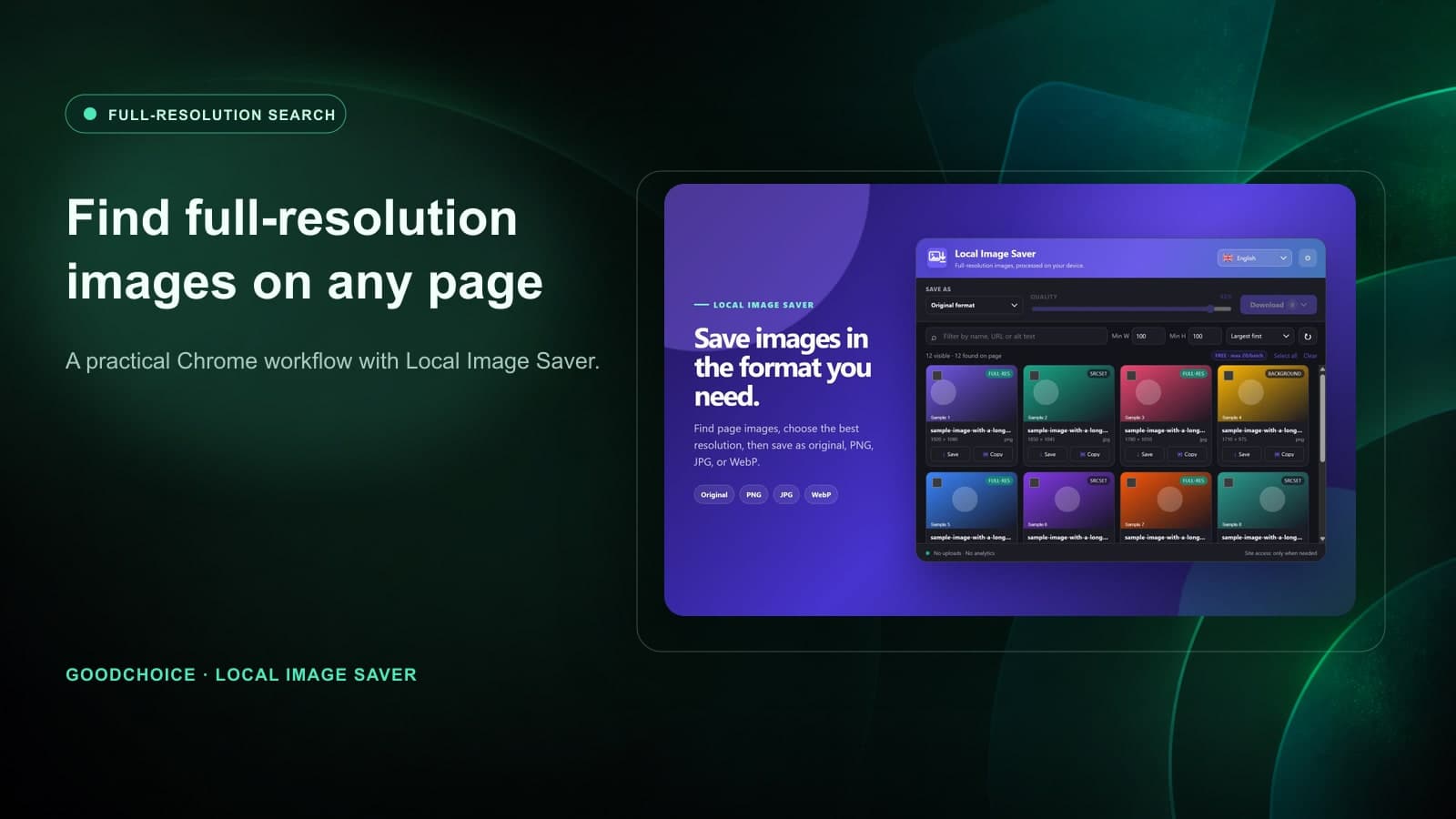
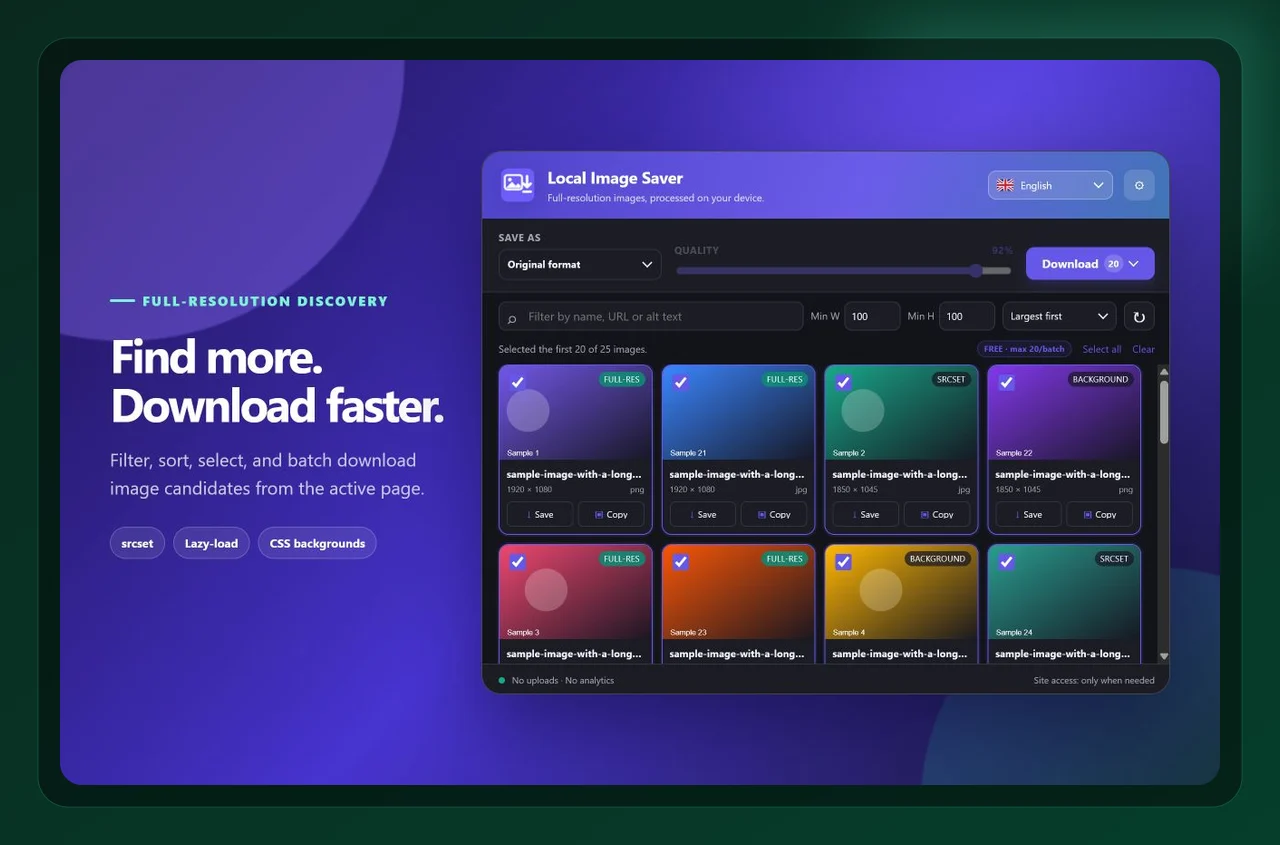
Local Image Saver is built for that decision point. It scans images available in the active page so you can review candidates in one place, then lets you save an original or choose PNG, JPG, or WebP for the selected items. scan the page, compare the candidates that Local Image Saver finds, and use dimensions as a practical signal before downloading. The goal is a repeatable inspection process rather than a fragile URL trick. The key advantage is that discovery, selection, conversion, and download remain in one browser workflow. That reduces context switching and makes it easier to repeat the process across several pages.
Step-by-step: find and download full-resolution images from a website
1. Start with the page and the outcome you need
Identify the section or gallery you care about and ensure it has loaded. Page scanning works best when the relevant imagery is present in the active document. Before opening the extension, decide what “success” looks like. Is this a source file for an archive, a transparent asset for a designer, a photo for a CMS, or a collection for a research board? That one decision makes the later format and size choices much easier.
2. Review before you download
Use the dimensions and preview to compare candidates. When several versions exist, start with the largest credible option and check that it is not merely an upscaled derivative. This is the moment to slow down briefly. A visual preview tells you more than a file extension, and dimensions help distinguish a usable source from a small derivative. If the page has several similar candidates, save one test file and verify it in the tool where it will actually be used.
3. Save a purposeful output
Save an original copy for reference, then convert only the copies that must go into a different workflow or format. Keeping an original and a purpose-built working copy is often the most resilient approach. It protects your source while allowing you to meet a specific upload, compatibility, or presentation requirement without retracing the page later.
Choose format and quality deliberately
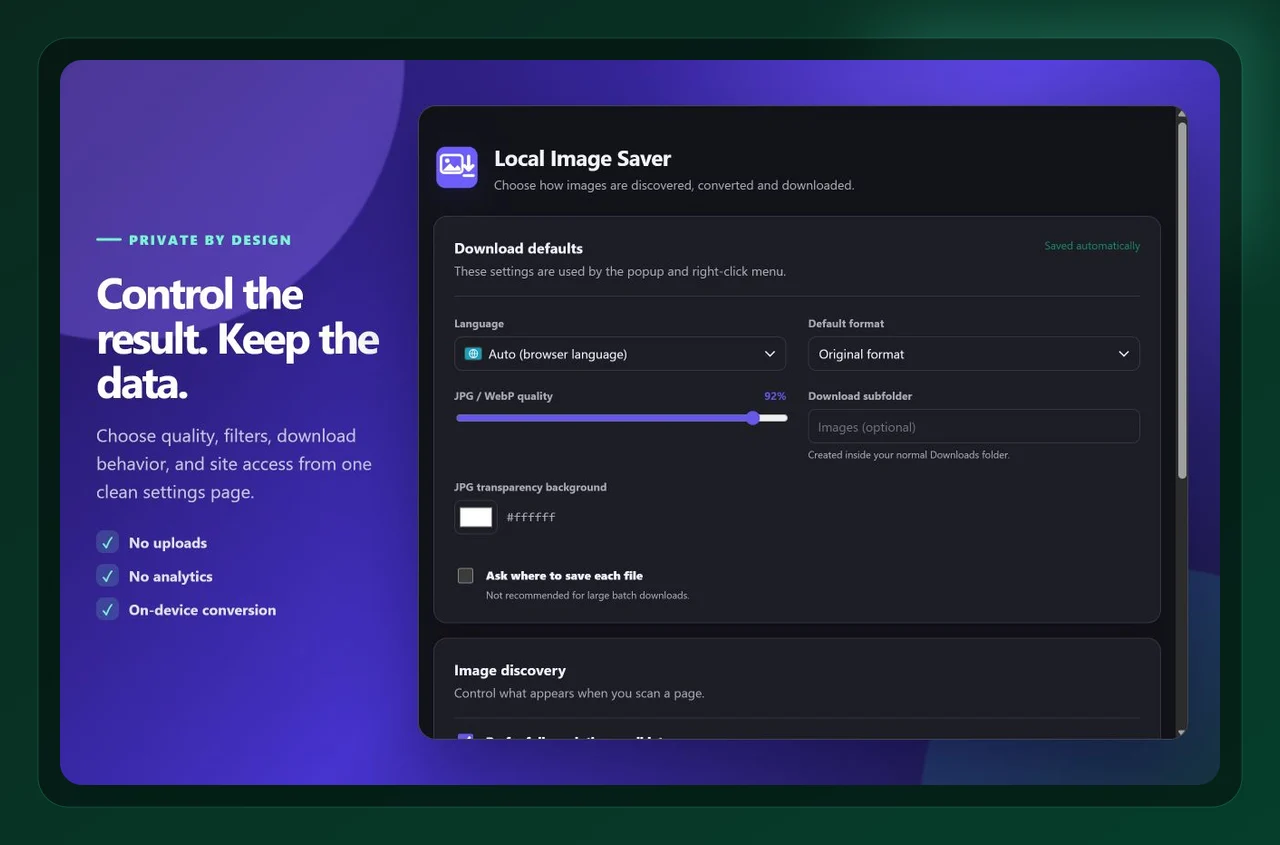
Full-resolution is contextual. A 2000-pixel image may be excellent for a desktop presentation and inadequate for a large print job. Decide what “enough” means before you begin searching. Format is a workflow decision, not a cosmetic afterthought. Think about the destination first: compatibility, file size, crisp edges, transparency, and future editing. A carefully chosen output saves time later because a teammate can open it, upload it, or place it without another round of conversion.
A quick quality-control checklist
- Set a minimum size based on your actual destination.
- Check whether the image is a thumbnail, responsive candidate, or background asset.
- Preserve an original before cropping or compressing a working copy.
- Use a clear filename for the source context.
- Do not confuse a browser zoom level with the file’s native resolution.
These checks take less time than repairing a poor download later. They also make a workflow easier to hand to another person: the source is clear, the output is intentional, and the destination folder tells the next person what the files are for.
Frequently asked questions
What does full resolution mean on a website?
It means the largest useful image resource made available to the browser for that piece of content. It does not guarantee an uncompressed camera original or unrestricted reuse rights.
Can I increase an image’s real resolution by saving as PNG?
No. PNG changes the file format, not the amount of detail. Start with the strongest candidate, then choose a format suitable for how you will use it.
Why are there multiple images with the same name?
Responsive image systems often supply several sizes for different devices and layouts. Comparing dimensions helps distinguish a display thumbnail from a larger candidate.
Final takeaway
The practical way to find and download full-resolution images from a website is to make the source, size, and format choices in one place instead of patching them together after the fact. Local Image Saver helps you do that directly in Chrome. Install Local Image Saver from the Chrome Web Store, or learn more about the product, then use the workflow on a real page before relying on it for a larger collection.

Local Image Saver
Save full-resolution images, convert formats in your browser